Tight vs Loose Coupling in Java Test Design
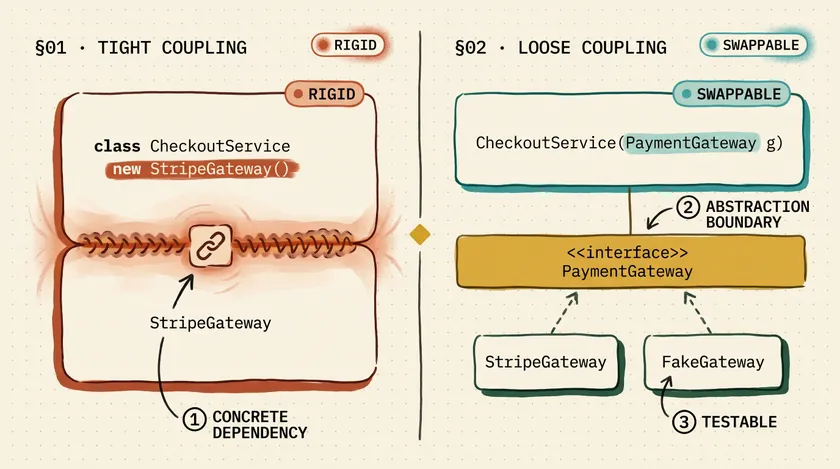
Table of Contents
Most coupling explanations stop at car-and-engine metaphors. In real Java code, coupling decides whether a change takes ten minutes or sends you through half the application just to update one behavior.
It also decides how easy your code is to test. That is the part I care about most.
This comes up constantly in automation code. The same design mistakes that make business logic hard to change are the ones that make page objects brittle, reporting code global, and parallel execution unsafe. If you’ve seen how shared state wrecks parallel test execution, you’ve already seen coupling debt in one of its most expensive forms.
What coupling actually means
Coupling is the amount of direct dependency one class has on another concrete implementation.
- Tight coupling means a class knows too much about a concrete dependency and often creates it itself.
- Loose coupling means a class depends on an abstraction and receives the dependency from outside.
Lower coupling is not automatically better in every line of code, but tighter coupling always raises the cost of change.
Tight coupling example
Here’s a checkout flow that directly creates its own payment dependency:
class StripeGateway {    void charge(int cents) {        System.out.println("Charging Stripe: " + cents);    }}
class CheckoutService {    private final StripeGateway gateway = new StripeGateway();
    void checkout(int totalInCents) {        gateway.charge(totalInCents);        System.out.println("Order completed");    }}
This works, but it creates three problems immediately:
CheckoutServicecannot be tested without touching the real payment implementation- replacing Stripe with another provider requires changing the class itself
- any setup logic inside
StripeGatewaybecomes unavoidable in every test
Loose coupling example
Now the same behavior, but with an abstraction:
interface PaymentGateway {    void charge(int cents);}
class StripeGateway implements PaymentGateway {    public void charge(int cents) {        System.out.println("Charging Stripe: " + cents);    }}
class CheckoutService {    private final PaymentGateway gateway;
    CheckoutService(PaymentGateway gateway) {        this.gateway = gateway;    }
    void checkout(int totalInCents) {        gateway.charge(totalInCents);        System.out.println("Order completed");    }}
Now CheckoutService only knows what it needs: something that can charge().
That opens the door to simple testing:
import static org.junit.jupiter.api.Assertions.assertTrue;
class FakeGateway implements PaymentGateway {    boolean charged;
    @Override    public void charge(int cents) {        charged = true;    }}
FakeGateway fakeGateway = new FakeGateway();CheckoutService service = new CheckoutService(fakeGateway);service.checkout(5000);
assertTrue(fakeGateway.charged);
No network calls. No real payment provider. No test environment gymnastics.
Constructor injection is usually enough
Teams sometimes hear “loose coupling” and jump straight into factories, service locators, and abstraction layers everywhere. Most of the time, simple constructor injection gets you 80% of the benefit with almost none of the ceremony.
When tight coupling is acceptable
Not every class needs an interface.
Tight coupling is usually fine when:
- the class is a tiny value object with no external dependency
- the dependency is part of the language or JDK and extremely stable
- there is genuinely no alternate behavior and no testing penalty
The mistake is not using tight coupling sometimes. The mistake is using it by default in code that will evolve.
Why this matters in automation code
This shows up constantly in test frameworks:
- page objects that instantiate drivers or API clients themselves
- utility classes that reach into static global state
- report managers that depend on one concrete reporting tool everywhere
- config classes that read files directly in every method
The result is brittle setup, hard-to-isolate tests, and code that becomes painful to parallelize. A lot of so-called framework complexity is really just coupling debt.
You can see the opposite pattern in frameworks that got the abstraction boundary right. One reason Playwright’s API feels lighter than many Selenium stacks is that it removed a lot of the wrapper indirection teams used to build by hand. I wrote more about that in my migration notes on Selenium wrappers vs Playwright locators.
A simple rule I use
If a dependency might change, might need to be faked in tests, or might behave differently across environments, I want loose coupling.
If it is pure, stable, and local, I keep it simple.
Where teams overdo it
I do not create interfaces for every helper class just to look “clean.” If there is only one stable implementation and no meaningful test benefit from abstraction, adding an interface is paperwork, not architecture.
Bottom line
Loose coupling is not about writing more interfaces to look architectural. It’s about keeping behavior swappable and testable. When a class depends on abstractions instead of concrete details, change gets cheaper, tests get smaller, and the design survives longer.
That is the practical payoff. Not elegance for its own sake, but code you can work on without fighting it.
Don't miss a thing
Subscribe to get updates straight to your inbox.

No spam · Unsubscribe anytime