Your AI Bug Reports Are Beautiful and Unreproducible
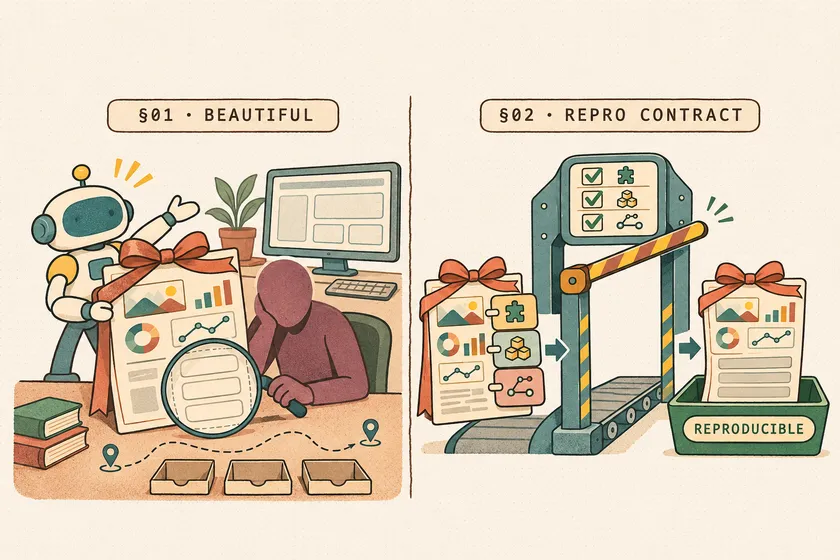
Table of Contents
Median time-to-triage per ticket went up after we turned on AI bug filing. Not down — up, from about 9 minutes to 22. The agent was filing 68 tickets a month against a 340-spec Playwright suite, and 41 of them got closed cannot reproduce. The tickets weren’t sloppy. They were better written than the ones my humans file — and each one cost a developer twenty minutes to disprove.
A bad human bug report announces itself in the first line — you skim it, you bounce it, you lose thirty seconds. A bad AI bug report reads like a good one all the way to the bottom. AI generated bug report quality doesn’t fail loudly. It fails expensively.
68
Agent-filed tickets, month 1
41
Closed cannot-reproduce
2.4× slower
Triage per agent ticket
Why can’t developers reproduce AI-generated bug reports?
Because an LLM writing from a failed test run knows what it saw, not what state the system was in when it saw it. The trace holds the DOM, the network calls, and the assertion that blew up. It does not hold the one fact that makes the failure happen again: the precondition.
Here’s the ticket that finally made this click for me. At a Canadian payments company, the agent filed a clean report against the checkout flow — expected a declined-card banner, got a spinner that never resolved. Steps to reproduce: add item, go to checkout, submit payment. Perfectly reasonable. Perfectly useless. The test that failed was seeded with a merchant account whose card on file had expired 3 days prior, created by fixture merchant-expired-card-t3. Nobody could reproduce it because nobody else had that account. The agent never mentioned the fixture, because the agent never knew the fixture existed — it read the trace, and the trace starts after the seeding.
The model documents the symptom, not the state
This is a structural limit, not a prompting failure. Seeded data, feature-flag values, the build SHA, which worker ran it, whether a sibling test mutated a shared record — all of it lives outside the artifact the model is summarizing, and it only exists as a nameable value if you’re running in an environment whose seeds and flags you actually control. You can prompt “please include preconditions” until you’re out of context window; the model will comply by inventing plausible ones, which is worse than omitting them.
Fluency stopped being a quality signal
The open-source world hit this wall a year before enterprise QA did. Daniel Stenberg reported that roughly 20% of curl’s 2025 security submissions were AI slop, and the valid-report rate collapsed from over 15% to under 5% — “not even one in twenty was real.” Those reports cited fabricated GDB traces and plausible-looking commit hashes. His cost model is the line every QA lead should internalize: “Every report thus engages 3-4 persons. Perhaps for 30 minutes, sometimes up to an hour or three. Each.”
Don’t plan on filtering these out by spotting them. The OpenSSF working group concluded there is “no reliable technical indicator for AI-generated content: detection is often based on ‘vibes.’” Stop trying to detect it. Gate it.
What makes a good bug report in 2026?
A good bug report in 2026 is judged by its artifacts, not its prose: an executable reproduction script, a fault-localized file path, a trace. Steps to reproduce — the field humans rank #1 — turns out to have no significant effect on whether a coding agent can fix the bug, and longer reports cut fix odds by half. The audience changed; the format didn’t.
The same researcher published both halves of the evidence, 18 years apart.
In 2008, Bettenburg, Zimmermann et al. surveyed 466 developers and reporters across Apache, Eclipse, and Mozilla for What Makes a Good Bug Report?. Steps to reproduce ranked #1 in importance, at 83%.
In July 2026, Zimmermann co-authored What Makes a Good Bug Report for an AI Agent?, running 87 repair agents against 433 SWE-bench Verified issues. The findings invert the folklore:
| Report element | Effect on agent fix success |
|---|---|
| Fix suggestions | 3.61× higher odds |
| Repository source code | 2.82× |
| Executable reproduction script | 2.52× |
| Fault localization (naming files) | 2.33× |
| Prose “steps to reproduce” | no significant association |
| Longer reports | 51% lower odds |
Read those last two rows again. The thing humans rate #1 does nothing for an agent, and verbosity — the single most reliable output of an LLM told to write a bug report — actively hurts. Your tickets are increasingly read by coding agents, and you are optimizing them for a reader that doesn’t exist.
That’s the contract.
What is a repro contract?
A repro contract is a machine-checkable schema that any agent-filed ticket must satisfy before it lands in the backlog: exact preconditions, the fixture or seed ID, the environment and build SHA, the failing assertion verbatim, and a link to the trace artifact. Miss a field, and the ticket bounces automatically instead of costing a developer twenty minutes.
The point isn’t the field list — you’ll tune that. The point is where it’s enforced. Not in the prompt. Not in the issue template. At the write path.
The schema
{ "$schema": "http://json-schema.org/draft-07/schema#", "type": "object", "required": [ "fixtureId", "buildSha", "environment", "failingAssertion", "traceUrl" ], "properties": { "fixtureId": { "type": "string", "minLength": 3 }, "buildSha": { "type": "string", "pattern": "^[0-9a-f]{40}$" }, "environment": { "enum": ["qa", "staging", "uat"] }, "failingAssertion": { "type": "string", "minLength": 10 }, "traceUrl": { "type": "string", "format": "uri" }, "reproRate": { "type": "string", "pattern": "^\\d+/\\d+$" } }}Two details that cost me an afternoon. The draft-07 $schema URI is http://, not https:// — Ajv resolves it against its registered meta-schemas by exact string, and the https variant throws no schema with key or ref before it validates a single field. And omitting "type": "object" trips Ajv’s strict mode with a strictTypes warning on required.
reproRate is the field I’d fight for. “Failed 3 of 20 runs” reads like a weak bug report. It’s actually a race condition report, and it carries more information than any paragraph of prose.
Collecting the evidence in a Playwright reporter
The reporter is the only place that sees both the fixture metadata and the failure. Two landmines here that the docs state plainly and everyone trips over anyway: onTestEnd is typed void, so a promise you return from it is not awaited — and Playwright silently swallows anything you throw inside a reporter method. Collect, then await in onEnd.
import path from 'node:path';import type { Reporter, TestCase, TestResult } from '@playwright/test/reporter';
export default class ReproContractReporter implements Reporter {  private pending: Promise<void>[] = [];
  onTestEnd(test: TestCase, result: TestResult) {    if (result.status !== 'failed') return;    // TestError (reporter-side) has location + snippet.    // TestInfoError (test-side) does NOT — don't reach for .location there.    const assertion = result.errors[0]?.message?.trim() ?? '';    const trace = result.attachments.find((a) => a.name === 'trace');
    const ticket = {      fixtureId: test.annotations.find((a) => a.type === 'fixture')?.description,      buildSha: process.env.GITHUB_SHA,      environment: process.env.TEST_ENV,      failingAssertion: assertion,      // attachment.path is a path INSIDE the runner — publish it, then link it      traceUrl: trace && `${process.env.ARTIFACT_BASE_URL}/${path.basename(trace.path!)}`,    };    this.pending.push(fileIfCompliant(ticket)); // do NOT await inside onTestEnd  }
  async onEnd() {    await Promise.all(this.pending); // onEnd DOES await — onTestEnd doesn't  }}
The fixture annotation is the load-bearing line. The data factory that seeds your test accounts has to declare what it created — test.info().annotations.push({ type: 'fixture', description: 'merchant-expired-card-t3' }) — because nothing downstream can recover it. If your suite can’t name its own preconditions, no model will name them for you.
Enforcing it at the write path
import { Ajv } from 'ajv';            // named export, 8.13+import addFormats from 'ajv-formats'; // formats left core in v7import schema from '../.github/repro-contract.schema.json' with { type: 'json' };
// The agent appends the contract as a fenced JSON block. That fence IS the seam:// prose is for humans, the block is what the gate reads.const block = process.env.ISSUE_BODY?.match(/```json repro\n([\s\S]*?)```/)?.[1];if (!block) bounce('No repro-contract block found.');
const ajv = new Ajv({ allErrors: true });addFormats(ajv);const validate = ajv.compile(schema);
if (!validate(JSON.parse(block!))) {  // v8 renamed dataPath → instancePath. Snippets using dataPath are stale.  const bad = validate.errors!.map((e) => e.instancePath || e.params.missingProperty);  bounce(`Repro contract incomplete: ${bad.join(', ')}`);}
Make the agent emit the contract as a fenced json repro block and let it write whatever prose it likes around it. You get the fluency for free and the gate reads only the part that can’t be improvised.
Why isn’t a GitHub issue template a gate?
Because required: true in a GitHub issue form only works in public repositories. GitHub’s own form-schema docs say it verbatim — “Only for public repositories.” In a private or internal repo, which is where every enterprise team lives, the asterisk renders and the validation silently does nothing.
That one surprised me enough to go test it. The template your team argued about for two sprints is decorative in the browser, and it’s doubly decorative via the API: POST /repos/{owner}/{repo}/issues accepts a title and a free-form body string. There is no template parameter. Nothing to validate against.
So the gate runs in CI, on the issue event, where you control it:
on:  issues:    types: [opened, edited]   # 'edited' too, or an author edits compliance away
permissions:  issues: write  contents: read   # declaring ANY permissions block zeroes the rest — checkout needs this
jobs:  gate:    runs-on: ubuntu-latest    steps:      - uses: actions/checkout@v4      - run: npx tsx scripts/validate-ticket.ts        env:          ISSUE_BODY: ${{ github.event.issue.body }}  # via env — issue bodies are attacker-controlled          GH_TOKEN: ${{ secrets.GITHUB_TOKEN }}
Is AI generated bug report quality fixing itself?
Partly. The strongest objection to this whole post is that I’m describing a 2025 problem that better models have already outgrown, and that objection has real evidence behind it.
curl killed its bug bounty in January 2026, then returned to HackerOne in March with zero monetary rewards — and the valid-report rate snapped back to 15-16%, pre-AI levels, even as volume doubled. Stenberg now says almost every report uses AI to some degree and they’re “mostly very high quality.”
So models got better. Fine. But look at what actually fixed curl’s signal-to-noise ratio: not a better prompt, and not a better model. They removed the payout for submitting an un-evidenced report. That’s a gate — a change to the write path, made before the models improved. Better models raise the floor on prose quality. They do not give an LLM access to a fixture ID it never saw.
What I’d do differently
Ship the gate in the same PR as the agent. We ran unguarded for a quarter because the first two weeks looked great — tickets appeared, the backlog grew, everyone felt productive. Backlog growth is not a health metric. By the time the cannot reproduce pile was undeniable, developers had already learned to deprioritize anything filed by the bot, which meant the two genuine regressions buried in that pile sat for six weeks. That’s the same failure mode as making a test pass instead of fixing what it caught.
Six weeks after the contract went in, the agent was filing 19 tickets a month instead of 68, and cannot reproduce closures dropped from 41 to 3. The agent didn’t get smarter. It just stopped being allowed to file the ones it couldn’t evidence — and the 49 tickets a month it stopped filing were the ones that were costing us twenty minutes each.
The rollout I’d use next time, and the one I actually used:
| Week | What I did | What I’d do |
|---|---|---|
| 0 | Agent ships alone | Gate ships in the same PR |
| 1-2 | Celebrate the backlog | Quarantine label only — nothing bounces yet |
| 3 | — | Hard-bounce on fixtureId + traceUrl only |
| 16 | Panic, add contract | Full schema |
Start with a quarantine queue rather than a hard bounce. Non-compliant tickets go to a holding label, not to /dev/null — a human skims it weekly, and the ones that turn out to be real tell you which contract field you forgot to require.
The one action worth taking today: open your five most recent agent-filed tickets and check whether any of them names the fixture, seed, or account the failing test ran against. If none do, the problem isn’t your prompt — it’s an unenforced contract, and the same rule applies here as when you let a model triage failures rather than decide them. Let the agent format the report. Don’t let it decide what belongs in one.
Can't I just write a better prompt to make the AI include preconditions?
No. The precondition data usually isn’t in the artifact the model is summarizing. A Playwright trace starts after fixture seeding, so the fixture ID, feature-flag state, and build SHA are structurally outside the model’s evidence. Prompted for preconditions it lacks, an LLM will produce plausible invented ones — worse than an omission, because they read as fact.
Does a GitHub issue template enforce required fields?
Only in public repositories. GitHub’s form-schema docs state that validations.required is “Only for public repositories” — in a private or internal repo it renders the asterisk and enforces nothing. It’s also unenforceable via the REST API, which accepts a free-form body string with no template parameter. Enforce the schema in a workflow on the issues event instead.
Should I use an LLM to grade the quality of AI-filed bug reports?
Not as the only gate. Research on bug-bounty triage found LLMs consistently struggle to detect invalid submissions and tend to over-accept reports — so using a model to grade model output is circular. Use deterministic schema validation (Ajv) for the required fields, and reserve the LLM for ranking or summarizing what already passed.
What is a repro contract?
A machine-checkable JSON schema that an agent-filed ticket must satisfy before entering the backlog: fixture or seed ID, build SHA, environment, the failing assertion verbatim, and a trace artifact link. It’s validated at the write path — in CI on the issues event — so non-compliant tickets bounce automatically rather than costing a developer twenty minutes of failed reproduction.
Isn't a non-reproducible bug report still worth filing?
Yes, but file it as data rather than prose. “Failed 3 of 20 runs on worker 4” is a race-condition report, and it belongs in the ticket as a reproRate field. What fails is the report that describes a deterministic bug that isn’t deterministic — that’s what burns triage time and trains developers to ignore the queue.
Don't miss a thing
Subscribe to get updates straight to your inbox.

No spam · Unsubscribe anytime