QA Lead Responsibilities: What the Role Actually Looks Like
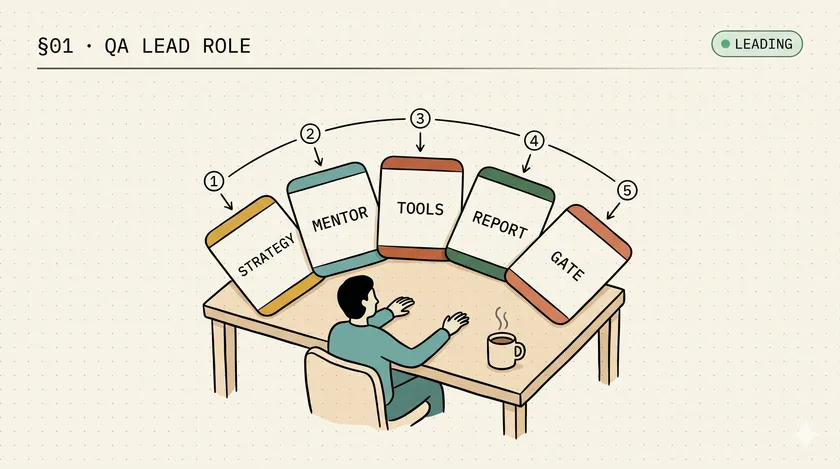
Table of Contents
The QA lead role is one of the most confusingly defined titles in software. Some companies use it to mean “senior tester with extra meetings.” Others mean a full management role minus the budget and headcount authority. The job description on the careers page rarely matches what the person in the seat actually does on a Tuesday afternoon. This post is the clear, unhyped explanation of what a QA lead is responsible for, how the role differs from the roles next to it, and whether it’s the right next step for your career.
If you’re a mid-level QA engineer wondering whether to aim for QA lead, an engineering manager trying to understand what to expect from one, or someone who just got promoted into the role and is figuring out what they actually own — this is for you.
What does a QA lead actually do day-to-day?
A QA lead is the senior technical voice for testing on a team. They own the test strategy, the tools the team uses, the quality of the test suite, and the growth of the testers around them. They are usually not the people manager — that’s a QA manager or an engineering manager. But they own how testing happens.
In every enterprise role I’ve held — at a large Canadian telecom, a national lottery operator, a global retailer, and a multinational insurer — the QA lead’s week consistently came down to five recurring areas of work.
The five universal responsibilities
These five show up in every credible source on the role, from the ISTQB Lead Tester definition to vendor career guides to job postings. They are the table stakes of the role.
- Test strategy and planning. Decide what gets tested, how, and with what tools. Set the scope for each release. Define what “done” looks like for quality. Translate product risk into test priorities.
- Mentoring testers. Pair-test with juniors. Review their automation pull requests. Help mid-level engineers grow into seniors. Run craft sessions on new tools or patterns.
- Tool and framework decisions. Pick the automation stack. Decide when to migrate. Maintain the framework architecture. Approve or block third-party tooling that affects test infrastructure.
- Stakeholder reporting. Build the dashboards that show coverage, flaky tests, defect leakage, and release readiness. Translate technical reality into language product managers and engineering directors will act on.
- Risk management and quality gates. Decide what blocks a release and what doesn’t. Own the conversation when a release is risky. Take the heat when a bug ships and the room asks “why didn’t QA catch it?”
Everything else — environment ownership, CI pipeline access, hiring input, training budget — varies by company. These five are the ones you’ll find in every QA lead role you take.
What 40 hours actually looks like
The thing every job description hides is that a QA lead’s week is mostly not testing. Here’s the breakdown I’ve kept across three different enterprise roles, each on a team of 8-14 testers:
Meetings (planning, standups, stakeholder reporting)
Hands-on test/automation work
Mentoring and code review
Strategy, docs, dashboards
Reactive triage (incidents, flaky tests, urgent asks)
The bigger the team, the smaller the hands-on slice gets. On a team of 4 testers I was still writing tests almost daily. On a team of 14, hands-on work shrank to maybe 10 hours a week — and that included framework code more than test cases.
How is a QA lead different from a QA manager?
A QA lead owns the technical and tactical work — test strategy, tooling, mentoring on craft. A QA manager owns the people and process work — performance reviews, hiring, headcount budgets, conflict resolution. Some companies have both. Many enterprises have only one of the two and expect that person to do both jobs.
The cleanest way to remember it: the lead asks “are we testing the right things, the right way?” The manager asks “do we have the right people, growing in the right direction?”
| Area | QA Lead | QA Manager |
|---|---|---|
| Test strategy | Owns it | Approves it |
| Tool selection | Decides | Funds |
| Mentoring | Day-to-day, on craft | Career-level, on growth |
| Performance reviews | Provides input | Writes and delivers |
| Hiring | Technical interviews | Headcount, offers, sign-off |
| Stakeholder reporting | Test results, risk | Team capacity, budget, roadmap |
| Title above them | QA Manager or Eng Manager | Director of QA or VP Engineering |
In smaller orgs (under 100 engineers), one person often does both jobs and the title is whatever HR settled on. In larger enterprises, the lead is the senior IC voice and the manager is the people leader. The two roles work in tandem — and in healthy orgs, the lead has direct input into who gets hired and how performance is evaluated, even if they don’t write the reviews.
How is a QA lead different from an SDET or senior QA engineer?
An SDET is an individual contributor focused on building and maintaining test automation infrastructure. A senior QA engineer is a senior IC who tests, and may automate. A QA lead has those skills but adds team coordination, strategy ownership, and stakeholder communication on top.
The simplest way to think about it: SDET and senior QA engineer are both IC ladders. QA lead is where the ladder branches into a leadership track. The work overlaps, but the accountability is different.
| Area | Senior QA Engineer | SDET | QA Lead |
|---|---|---|---|
| Primary focus | Testing features | Building test infrastructure | Testing strategy and team |
| Coding time | 20-40% | 60-80% | 10-25% |
| Owns the framework? | No | Yes | Yes (with the SDETs) |
| Owns the strategy? | No | No | Yes |
| Mentors others? | Sometimes | Often, on automation | Always |
| Stakeholder-facing? | Rarely | Sometimes | Daily |
| Career ladder | IC | IC | Leadership |
A senior SDET and a QA lead are roughly peer-level in seniority but sit on different career ladders. The SDET keeps climbing on the IC track — toward staff SDET, principal SDET, or test architect. The QA lead climbs the leadership track — toward QA manager, head of quality, or director of engineering with QA scope.
Both ladders are legitimate. They pay differently, which I’ll get to in a moment. For more on how the SDET role itself is shifting, see my post on how the SDET role is evolving in 2026.
What skills does a QA lead actually need?
The hard skills are the ones every job posting lists. The soft skills are the ones that determine whether you survive the role.
Hard skills
- Test strategy thinking. Risk-based prioritization, coverage analysis, knowing when to test more vs. when to ship.
- Automation literacy. You don’t need to write all the framework code, but you need to read it, review it, and make architectural calls. If you can’t tell whether a test is fragile by reading it, you can’t lead the team.
- CI/CD understanding. Know what blocks the pipeline, what slows it down, and what your tests do to it. The infrastructure decisions a QA lead makes here are covered in detail in my post on building a test environment you control.
- Tooling judgment. Be able to evaluate Playwright vs. Cypress, REST Assured vs. Karate, Jenkins vs. GitHub Actions — without falling for vendor pitches.
- Defect analysis. Read a defect log and know what story it tells about your team’s process.
Soft skills (the ones that actually decide your fate)
- Translation. You spend your day translating engineering reality to product, product priorities to engineering, and bug data to leadership. The technical work is the easy part.
- Standing your ground. A bug ships. The product manager wants to know why QA didn’t catch it. You need to walk them through what happened without throwing your team under the bus and without becoming the scapegoat yourself.
- Reading the room. When a release is risky, you need to know whether to escalate now, wait until the next standup, or ping the engineering manager privately. Get this wrong and you either become “the person who panics” or “the person who didn’t speak up.”
- Mentoring without micromanaging. Junior testers need direction; senior ones need air cover. Treating them the same way fails both.
- Saying no to scope. Test scope expands until something breaks. Knowing when and how to push back on adding “just one more thing” to the regression suite is a survival skill.
Should you aim for QA lead or stay technical?
Here’s where most online guides hedge with “it depends.” I’ll give you a clearer answer: at top-tier tech employers in 2026, taking a QA lead role can be a pay cut from senior SDET. If money and technical depth matter to you, that’s worth knowing before you accept the promotion.
The salary reality
Numbers from the most recent BLS data, Glassdoor, and the KORE1 QA salary guide — all US figures, base salary unless noted:
QA Lead base, Glassdoor 2026 avg
Software QA Lead avg, Glassdoor 2026
QA Analyst/Tester median, BLS 2024
Senior SDET base, top-tier tech (KORE1)
Senior SDET total comp, top-tier tech (KORE1)
The spread is wide because “QA Lead” is a generic title that means very different things at a fintech startup, a consulting firm, and a FAANG-tier employer. Glassdoor’s QA Lead total pay range is $73K-$135K once bonuses are included. But across the credible sources, one pattern is consistent: senior SDETs at top tech companies out-earn QA leads at the same companies. KORE1’s 2026 guide explicitly notes that QA lead and manager roles are getting harder to fill because the IC track pays better.
In Canada, where I work, QA lead averages around CA$146,250 according to Talent.com. The market is fragmented, and your number depends heavily on whether your company has a real engineering ladder or a consulting-firm structure.
A simple decision framework
Is there a QA Manager or Head of Quality above the lead role?
If yes, the lead role is a real stepping stone with growth above it. If no — if you’d be the most senior QA voice with no one above you to advocate for the function — be careful. You’d own the function without the authority to change it.
Do you actually enjoy translation work?
The QA lead role is 60-70% communication. If your favorite part of the job is solving a tricky test problem at 2 PM with headphones on, the lead role will frustrate you. If you light up when a flaky test triage ends with two teams agreeing on a contract, this is your role.
What's your alternative?
If your alternative is “stay senior IC at a company with a real staff/principal IC ladder,” staying technical may pay more and frustrate you less. If your alternative is “stay senior IC at a company where the IC ladder ends at senior,” then QA lead is your only real growth move and you should take it.
What does the next title up actually look like?
Ask the engineering manager: “What does the QA manager role look like above this one? Who would I report to in 18 months?” If they can’t answer clearly, the lead role might be a structural dead end and you should treat it as a 2-3 year stepping-stone, not a destination.
I’ve taken QA lead roles twice and turned one down. The two I took were at companies with a real QA function and a clear path to QA manager or director. The one I turned down was a “lead of one” role where the company wanted a senior tester with the title bump but no headcount, no strategy authority, and no manager above me. That’s the trap. Avoid it.
For a related read on how accountability — not just title — determines whether QA leadership actually works, see why shift-left testing usually fails the way it does.
Frequently asked questions
Does a QA lead still write code or automation?
Yes, most QA leads still spend 10-25% of their time hands-on with automation, reviewing test code, or prototyping framework changes. The percentage drops as team size grows past 6-8 testers, and as more time goes to stakeholder communication. If you want to stay primarily hands-on, the SDET track is a better fit than the lead track.
How is a QA lead different from a QA manager?
A QA lead owns the technical and tactical work — test strategy, tooling, mentoring on craft. A QA manager owns the people work — performance reviews, hiring, headcount budgets. Some companies have both, with the lead reporting to the manager. Many enterprises have only one of the two and expect that person to do both jobs, which is one of the most common reasons the role gets confusing.
Do QA leads earn more than senior SDETs?
Not at top-tier tech employers. Senior SDETs at FAANG-tier companies often earn $145K-$170K base and $200K+ total comp, while QA lead total pay averages sit in the $73K-$135K range on Glassdoor. At consulting firms and traditional enterprises, the lead role often pays more than IC roles. Your specific company matters more than the title — always check the actual band before accepting a “promotion.”
How do I become a QA lead from senior QA engineer?
Start owning leadership tasks before the title. Write the test strategy doc nobody asked for. Mentor a junior on your team. Run a tooling evaluation and present the results. When you’re already doing the work informally, the title is a formality. Most QA leads I’ve worked with were promoted after 12-18 months of demonstrating leadership in their senior IC role — not by asking for the title and then growing into it.
Are QA leads still relevant in Agile teams?
Yes, but the role looks different. In waterfall, the QA lead owned a release-bound testing phase. In Agile, the lead owns the testing function across multiple squads — quality strategy, framework architecture, craft development — while individual testers embed in squads alongside developers. The role survives at the practice or chapter level even when there’s no dedicated QA team per squad. What dies in Agile is the test lead role tied to a single project release.
Where to start if you’re aiming for the role
If you want to grow into a QA lead, do one thing this week: pick a problem your team has been complaining about (a flaky test suite, a slow pipeline, a coverage gap, an unclear release process) and write a one-page proposal for fixing it. Share it with your manager. The work of a QA lead is exactly this — diagnosing problems, writing the fix, getting buy-in, then leading the implementation. The title is just recognition for already doing it.
If you’re already in the role and figuring out what to focus on, start with the dashboard nobody else builds. Most teams have no clear view of their own quality data. The QA lead who builds the first credible release-readiness dashboard becomes the person leadership trusts on quality calls. Everything else — strategy, hiring input, framework authority — flows from being trusted with the data.
Don't miss a thing
Subscribe to get updates straight to your inbox.

No spam · Unsubscribe anytime