The Only QA Job Left in 2026 Is the One That Codes
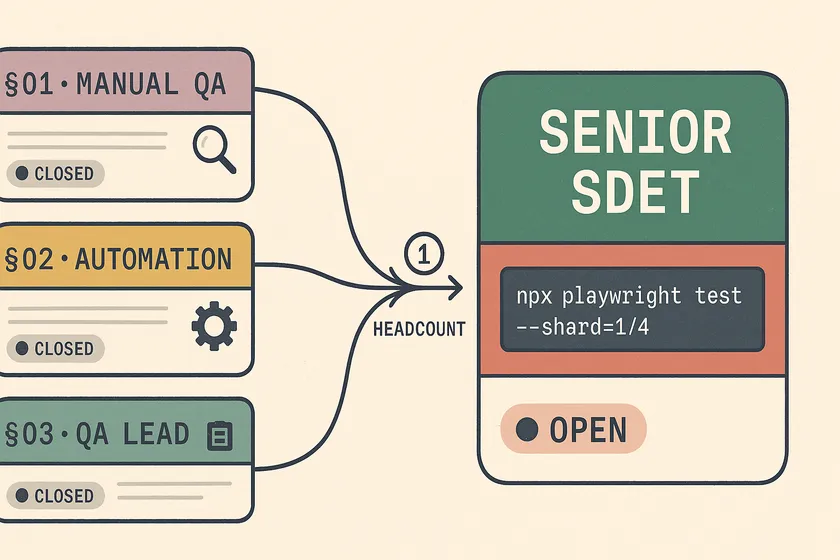
Table of Contents
Last year a client of mine — a global retailer — opened three requisitions: a manual QA analyst, an automation engineer, and a QA lead. By the time the reqs cleared budget review, someone in HR had merged them into a single posting titled “Senior SDET.” Same headcount money. One hire instead of three. Nobody announced a strategy shift. It just happened, quietly, in a spreadsheet.
That is the SDET job market in 2026 in one anecdote, and the internet is being useless about it in two opposite directions. One camp says QA is dead. The other says AI will never replace testers, so relax. The second is worse, because it’s condescending to the person actually losing ground.
Here’s the honest version. AI didn’t delete your job. It deleted the middle of your job.
The bottom — executing test cases somebody else designed — is going to agents. The top — deciding what’s worth testing, owning the infrastructure it runs on, telling a PM “no” with evidence — is getting more valuable. What’s been hollowed out is the part in between, the part that used to be the whole moat: I can write the automation. That skill went from scarce to cheap in about eighteen months.
Is manual testing dead in 2026?
No. Manual testing is alive and load-bearing — exploratory testing still finds the bugs your suite was never designed to look for. What’s dying is the job title that does only that. The activity survives; the seat with “Manual QA Analyst” on the org chart is being folded into a broader role.
The numbers say this is not a profession in collapse. The US Bureau of Labor Statistics counts 201,700 QA analysts and testers employed as of May 2024, median wage $102,610.
But look at where the openings are. Indeed’s Hiring Lab reported in July 2026 that 71% of the growth in tech postings between May 2025 and May 2026 came from senior roles. The market is hiring. It’s hiring above you. The bottom rung is the part being sawn off — and that rung is where manual testers have always entered and where they’ve historically been safe.
What is collapsing in the SDET job market?
Three roles are being compressed into one: the person who tests, the person who automates, and the person who decides what to test. AI is the accelerant, not the cause — code generation made the automation half cheap enough that it stopped justifying a dedicated headcount. The r/QualityAssurance thread that prompted this post put it plainly: everyone now wants to hire senior SDETs who work on test infrastructure and act like a QA lead.
I got this half-right before. When I wrote about what the SDET role looks like in the age of AI, I argued the role was moving up a level rather than disappearing. That held. What I didn’t say plainly enough is what “moving up” costs: a role that moves up is a role fewer people can stand on.
The cause also predates AI. Shift-left already loaded dev-adjacent work onto QA without moving anyone’s accountability. Once QA is writing code and owning pipelines anyway, the org eventually notices it’s paying for three titles to do one job. The 2026 market is that realization arriving at the budget meeting.
The AI line in the job posting is decoration
Here’s the gap I haven’t seen written down, and it’s the most useful thing in this post.
The World Quality Report 2025-26 — 2,000+ executives across 22 countries — found generative AI is now the top-ranked skill quality engineering leaders say they want. The same report found almost nobody has operationalized it.
63%
Leaders ranking GenAI their #1 QE skill
15%
Orgs with GenAI scaled to enterprise level
1 in 3
Reporting minimal productivity gains
Sit with the first two. Leaders are demanding a skill their own organizations have not shipped. So “experience with AI-assisted testing” lands in the posting because a VP asked for it — and then the interview loop has no way to assess it, because nobody on the panel has shipped it at scale either.
I’ve sat on SDET panels at a global retailer and a multinational insurer. The AI bullet came up in conversation and never once as a gate. Not one candidate was rejected for weak AI tooling experience. Plenty were rejected on debugging.
What screens you out of an SDET loop?
Not the AI question, and not Playwright syntax — anyone can look up a locator API. Candidates get screened out when they describe automation as writing scripts rather than owning a system, and it surfaces within about ninety seconds of the technical conversation starting.
The question that does the most work on my loops is deliberately boring:
“Tell me about the last time your suite went red and it turned out not to be a bug.”
Someone who has owned a suite answers instantly and with texture. They talk about a race condition between a test and a seeded fixture, an expired cert on a staging dependency, a runner with a different Node version, a shared test user that two parallel workers grabbed at once. They know what a flake tastes like.
Someone who has only executed test cases says “I’d escalate it to the automation team.” That answer ends the loop — but it’s a coachable gap, not a character flaw. The fix is to go get one real story. Own one flaky test end to end, all the way to the root cause, and you have the answer. It’s a weekend, not a degree.
What the posting says vs. what the panel selects for
| The job posting says | The panel selects for |
|---|---|
| ”Experience with AI-assisted testing tools” | Can you tell when the generated test is wrong? |
| “5+ years test automation experience” | Can you debug a failure you did not write? |
| ”Strong Selenium/Playwright skills” | Can you read a CI config and explain why the job is slow? |
| ”ISTQB certification preferred” | (Never once discussed. Not in any loop I’ve been on.) |
| ”Excellent communication skills” | Can you tell a PM “no” with evidence? |
The most reliable signal I’ve seen is whether a candidate can debug code they didn’t write. It’s the closest proxy for the actual job, which in 2026 is mostly inheriting somebody’s suite and being accountable for it.
The durable role is a QA lead who ships infrastructure code — someone who opens PRs against the pipeline rather than running a status meeting about a suite they don’t own:
jobs: e2e: runs-on: ubuntu-latest strategy: fail-fast: false matrix: shard: [1, 2, 3, 4] steps: - run: npx playwright test --shard=${{ matrix.shard }}/4The sharding is the boring part. fail-fast: false is the part that marks experience: without it, one dead shard cancels the other three and you see a single failure instead of all of them — so you fix one bug per pipeline run instead of four. On a retail client’s suite, four-way sharding took the e2e job from 38 minutes to 11. Being the person who writes that, defends it in review, and owns it at 2 AM is what a senior req is buying.
The part that’s genuinely bad news
I won’t pretend this is fine for everyone. If you have eight years of manual QA, a mortgage, and no code, the market has repriced you — and “AI just augments testers” is how the industry avoids telling you.
Robert Half’s 2026 guide puts the midpoint for a QA analyst at $89,250 against $102,500 for a QA automation engineer. That’s a ~15% gap, not the $40K leap the career-change influencers promise. The upside is real but modest. The downside of standing still is not modest at all.
Now the harder half, which nobody will say to you directly. Whether this is a gap or a rebuild depends on what your eight years were actually made of.
If you’ve spent them building product intuition — knowing which claim states break, which promo codes blow up at checkout, where the data gets weird at month-end — then you have the expensive half already. A model doesn’t have it and a bootcamp grad hasn’t earned it. What’s missing is the ability to express it in code, and that’s genuinely closeable.
If you’ve spent eight years executing a regression pack somebody else wrote, clicking through the same 200 steps each release, that’s not a gap. That’s a rebuild. It’s still doable, and it’s better to hear it from me than to infer it from six months of silent rejections.
What should you learn first?
Learn to debug someone else’s failing test in a CI environment you don’t control. That’s the highest-leverage skill in this market, the one the panel actually tests, and the one no certification teaches. Do these in order — not in parallel:
- One language, properly. Python or TypeScript. Not “familiar with” — can-write-a-class-and-defend-the-design fluent. Java if your target employer is a Java shop, and plenty of banks, insurers, and telecoms still are.
- Read a CI config and make it faster. Sharding, caching, parallelism. Break your own pipeline and fix it. This is what makes you infrastructure-adjacent, which is where the surviving headcount lives.
- Debug a flake you didn’t write. Find an open-source project with a flaky suite. Fix one. That story is now your interview answer.
- Then AI tooling. Last. It’s the loudest bullet in the posting and the weakest gate in the room.
Safe to ignore for now: ISTQB and most QA certifications (never came up in a single loop I’ve sat on), low-code test tools (they solve the cheap half of the job), and the entire genre of LinkedIn post promising prompt engineering is the new QA. The 15% number tells you how much of that is real.
Do this one thing this week
Open your team’s CI pipeline. Find the slowest job. Work out why it’s slow, write the fix, and open the PR — even if it gets rejected, even if it’s four lines of YAML.
That PR is the artifact. It’s what turns “I have QA experience” into “I own quality infrastructure,” and it’s the exact evidence the panel is looking for and almost never gets. One merged pipeline PR will do more for you in this market than a year of certifications.
For the record: the retailer that merged three reqs into one hired an automation engineer who’d been quietly maintaining their Jenkins config for two years. Not the strongest tester in the pool. The one who owned infrastructure.
Is it too late to become an SDET in 2026?
No, but the entry path has changed. Indeed’s Hiring Lab found 71% of tech posting growth in 2025-2026 came from senior roles, so breaking in cold is harder than it was. The realistic route is lateral: automate the domain you already test manually, and let that be your portfolio — rather than restarting as a junior and competing on a rung that is being removed.
Do I need to learn Python or Java for SDET roles in 2026?
Pick one and get genuinely fluent rather than sampling three. Python and TypeScript have the widest surface area across testing and tooling. Choose Java if your target employer is a Java enterprise — plenty of banks, insurers, and telecoms still are, and that’s where the senior reqs live.
Do SDET job postings actually require AI skills, or is that hype?
Mostly hype at the gate. The World Quality Report 2025-26 found GenAI is the top-ranked skill QE leaders want (63%), while only 15% of organizations have scaled it to enterprise level. On the loops I’ve sat on, no candidate was rejected for weak AI tooling experience. Plenty were rejected on debugging.
Will AI replace manual testers entirely?
AI replaces test execution, not test judgment — but that distinction only protects you if you actually have the judgment. A tester with deep product intuition is safe. A tester who has spent years executing a script somebody else wrote is doing precisely the part that automates cleanly, and that job title is disappearing.
Is an ISTQB certification worth it for the 2026 market?
Not as a hiring signal. Across the enterprise SDET loops I’ve been part of, certifications were never once a discussion point. One merged pull request against a CI pipeline demonstrates more than any certificate on a resume.
Don't miss a thing
Subscribe to get updates straight to your inbox.

No spam · Unsubscribe anytime