Cypress vs Playwright CI Cost in 2026: The Real Math
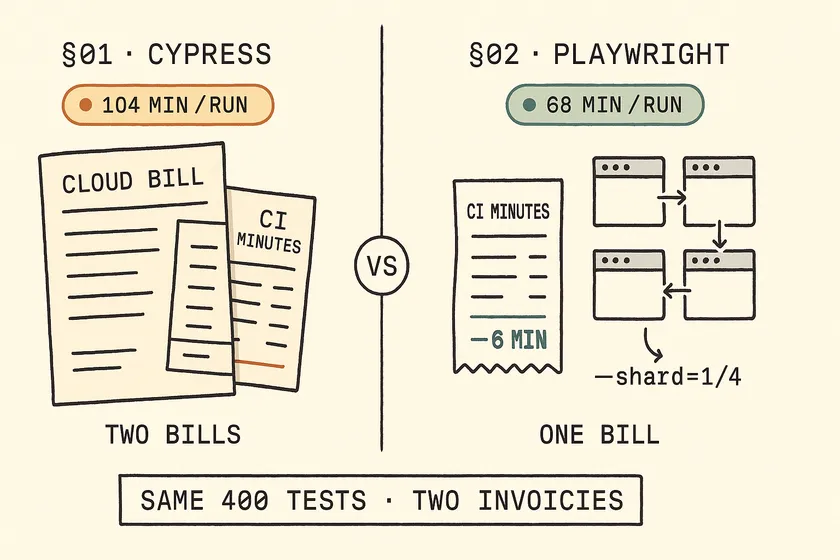
Table of Contents
Same 400 tests, same GitHub Actions runners, two very different invoices. The Cypress pipeline billed 104 runner minutes per run; the Playwright port of the identical suite billed 68. That’s a 1.5x gap — not the “2.5x CI cost divide” you’ll see quoted in nearly every Cypress vs Playwright CI cost comparison in 2026. Then the Cypress Cloud invoice landed, and the real multiple wasn’t 2.5x either. It was closer to 7x.
The 2.5x figure traces back to a single listicle with “[Tested]” in the title and no methodology, no CI config, and no billing screenshots anywhere in the article — published on a site whose other beats include sweepstakes casinos. That number is now being laundered into AI Overviews and vendor blogs as settled fact. It deserves better scrutiny, because it’s wrong in both directions: it overstates the compute gap and badly understates what per-result billing does to a suite that runs on every PR.
Disclosure up front: I’ve used Playwright far more extensively than Cypress over the last four years, and this post is only about the money. For the feature-by-feature question — retry semantics, locators, the async model — see the case for keeping (or leaving) Cypress. This post is about what it costs to stay.
Why does the same suite cost more CI minutes in Cypress?
The same tests bill roughly 1.5x more runner minutes in Cypress because of two architectural decisions: Cypress runs your test code inside the browser, and it exits the browser between every spec file. Playwright runs out-of-process, reuses worker processes across test files, and spins up browser contexts instead of browsers — so it never pays the relaunch tax 57 times per run.
Our measured serial runtimes: 92 minutes for the Cypress suite, 54 for the Playwright port. Same application, same scenarios, same assertions. The gap isn’t test speed so much as overhead between tests — with 57 spec files, Cypress performed 57 browser launches per run, a cost users asked about for years before the issue was closed without changing the behavior. Playwright’s worker model reuses each worker’s browser across files, so the launch cost is paid once per worker, not once per spec — the same reason I tell teams to stop launching a browser per test.
A 1.7x serial gap compresses to about 1.5x once you parallelize, because both tools then pay identical per-machine setup costs (checkout, npm ci, browser install). Real, worth having — and nowhere near the headline number.
Same task, both tools: 4-way parallel on GitHub Actions
Here’s the identical job — run the full suite across 4 machines on every PR — in both tools. The difference that matters is on the highlighted lines.
Cypress — requires Cloud recording
name: e2e-cypresson: pull_requestjobs: cypress: runs-on: ubuntu-latest strategy: fail-fast: false matrix: machine: [1, 2, 3, 4] steps: - uses: actions/checkout@v7 - uses: cypress-io/github-action@v7 with: record: true parallel: true env: CYPRESS_RECORD_KEY: ${{ secrets.CYPRESS_RECORD_KEY }}Playwright — self-contained sharding
name: e2e-playwrighton: pull_requestjobs: playwright: runs-on: ubuntu-latest strategy: fail-fast: false matrix: shard: [1, 2, 3, 4] steps: - uses: actions/checkout@v7 - uses: actions/setup-node@v6 - run: npm ci - run: npx playwright install --with-deps chromium - run: npx playwright test --shard=${{ matrix.shard }}/4Functionally these are the same workflow. Economically they’re not. The Cypress version needs a CYPRESS_RECORD_KEY because parallelization requires Cypress Cloud to distribute specs — which means every test execution becomes a billable “test result” on your Cloud plan. The Playwright version’s sharding splits tests locally with --shard=x/y; no external service sees your run.
The one extra piece Playwright needs is report merging, since each shard produces its own report:
import { defineConfig } from '@playwright/test';
export default defineConfig({  reporter: process.env.CI ? 'blob' : 'html',  fullyParallel: true,  workers: process.env.CI ? 2 : undefined,});
A final job downloads all blob reports and runs npx playwright merge-reports --reporter html ./all-blob-reports. That job cost us about 4 billed minutes per run — I’ve included it in the math.
Can you run Cypress in parallel without Cypress Cloud in 2026?
Not realistically, at current versions. cypress run --parallel without recording fails with You passed the --parallel flag, but did not pass the --record flag — parallelization is coupled to Cloud by design, and the issue asking to decouple them has been open since 2018. The free escape hatches you’ll find in old Stack Overflow answers are mostly dead: Cypress 13 started blocking the cypress-cloud package that sorry-cypress and Currents relied on, and sorry-cypress hasn’t shipped a release since January 2024 while Cypress is now on 15.x.
The honest steel-man is cypress-split, which still works: it slices spec files across matrix jobs without any dashboard. What you give up is duration-based load balancing, unified run reporting, and flake analytics — which is a reasonable trade for a small suite and exactly the trade Cypress Cloud’s paid tiers exist to reverse. If your team evaluates cypress-split and decides they need the Cloud features anyway, that’s not a workaround failing; that’s discovering what you’re actually paying for.
The worked example: Cypress vs Playwright CI cost in 2026
Here’s the full month for our 400-test suite at a per-PR cadence — 10 full-suite runs per workday, 21 workdays, 210 runs a month. Estimates are labeled; check them against your own billing page.
| Criteria | Cypress 15 | Playwright 1.61 |
|---|---|---|
| Serial runtime (measured) | 92 min | 54 min |
| Wall clock, 4-way parallel | ~26 min | ~16 min |
| Billed minutes per run (incl. setup + merge) | 104 | 68 |
| Compute, 210 runs at $0.006/min (Linux 2-core) | ~$131/mo | ~$86/mo |
| Orchestration | ~$511/mo (est.) | $0 |
| Monthly total | ~$642 | ~$86 |
The compute invoice
Both compute numbers come from the same formula: billed minutes per run x runs per month x per-minute rate. GitHub’s Linux 2-core rate is $0.006/minute, and each matrix job bills separately, rounded up to the next minute. Cypress: 104 x 210 x $0.006 = $131. Playwright: 68 x 210 x $0.006 = $86. There’s your architecture gap in dollars: $45 a month. Nobody is scheduling a migration meeting over $45.
The orchestration invoice
The second invoice is where the comparison actually gets decided. 400 tests x 210 runs = 84,000 test results per month, or about a million a year. Cypress Cloud’s Team plan (starting at $67/month billed annually) includes 120,000 results per year — this suite exhausts the annual allowance in six weeks. Priced as Team-plus-overages at $6 per 1,000 extra results, that’s roughly $511/month; realistically you’d negotiate the Business plan (starting at $267/month plus usage) and land somewhere similar.
1.5x
Compute-only gap
~7.5x
Total bill gap
~80%
Cloud share of Cypress bill
So the viral number is wrong twice. On compute alone, Cypress cost us 1.5x, not 2.5x. On the total bill, it cost 7.5x — because the dominant line item isn’t runner minutes at all, it’s per-result billing that scales with tests × runs, an axis that faster tests do nothing to reduce.
Cadence flips the whole result. Run the same suite nightly-only (21 runs/month) and Cypress fits inside the Team allowance: $67 + $13 compute = $80/month, against Playwright’s $9. The ratio still says 9x; the invoice says $71 — a rounding error next to one engineer-day. Anyone selling you a fixed “Nx cheaper” multiple without asking about your run cadence is selling, not measuring.
Does adding more parallel machines lower your CI bill?
No — on either tool. Parallelism buys wall-clock time, not fewer billed minutes: 4 shards each pay their own checkout, npm ci, and browser install, so total billed minutes go up slightly with every shard you add, and GitHub rounds each matrix job up to the next full minute independently. On the Cypress side it’s worse in a subtler way: the Cloud bill doesn’t move at all, because per-result billing doesn’t care whether 400 results arrived from one machine or eight.
Playwright’s version of this tax is shard imbalance. Sharding splits by test count, not duration — an issue with 79 reactions and no resolution — so one shard stacked with slow tests gates the pipeline while the other three idle on your dime. If your motivation for parallelizing is cost rather than feedback speed, stop: as I argued in the parallel execution piece, parallelism is a latency tool. The cost levers are making the suite do less work per run and running it less often.
When is migrating off Cypress worth the money?
It’s worth it when roughly three years of your measured bill gap exceeds the loaded cost of the port — and at mid-size scale it usually doesn’t. Our client’s gap was $556/month, $6,672 a year. Porting 400 Cypress tests took two engineers about seven weeks; call it 3 engineer-months, roughly $60,000 loaded cost. I told them not to migrate on cost, and I’d tell you the same: the CI bill is the most-cited and least-sufficient reason to leave Cypress.
| Scale (our estimates) | Monthly bill gap | Port cost | Payback |
|---|---|---|---|
| 400 tests, 10 runs/day | $556 | ~$60k (3 eng-months) | ~9 years |
| 1,800 tests, 35 runs/day | ~$4,000+ (Enterprise tier) | ~$180k (12 eng-months) | Under 4 years |
| Greenfield project | n/a | $0 | Immediate |
The math flips at enterprise scale because per-result billing compounds brutally: at 1,800 tests running 35 times a day you’re generating over a million results a month, deep into custom Enterprise pricing where — by our estimates from client quotes — the annual gap reaches mid five figures. Percentages don’t justify migrations; absolute dollars do.
Stay on Cypress when:
- Your
tests × runsper month fits Team-tier volume — the gap is double digits a month - You actually use flake detection, spec prioritization, or auto-cancellation, not just parallelization
- The team is fluent in Cypress and the only complaint is the invoice
Migrate when:
- A per-PR cadence on a 200+ test suite has pushed you into Business/Enterprise pricing purely for parallelization
- Three years of the measured bill gap exceeds the loaded cost of the port
- The dollars and the feature-level signals point the same way — cost should be the confirming reason, never the only one
Starting a new project is the one case with a clean answer: Playwright — for the cost reasons here and the framework reasons I’ve compared side by side — and the cost question never comes up.
Run your own numbers this week
One concrete action: compute your own two-invoice total. Pull last month’s usage report from your GitHub billing page, filter to your E2E workflows, and multiply your Cypress Cloud results count by your overage rate. The formulas are billed minutes × rate and tests × runs × per-result cost. If the annual total is under one engineer-month of loaded cost, close the migration ticket and go fix your flaky tests instead. If it’s multiples of that, you now have the number that belongs in the business case — a real one, not a listicle’s.
Is Cypress parallelization free?
It’s available on the free Starter tier, but the tier includes only 500 test results per month — one full run of a 400-test suite, since every test execution is one billable result. Any real CI cadence means a paid plan. Pricing details: cypress.io/pricing.
What happens when you exceed the Cypress Cloud test result limit?
Recorded runs keep executing, but parallelization is disabled and new results are hidden until the next usage cycle or an upgrade — so your 4-machine matrix quietly degrades to four machines each running the full suite. On paid tiers you’re billed overages instead: $6 per 1,000 extra results on Team, $5 per 1,000 on Business.
Is Playwright sharding really free?
Yes — --shard=x/y, the blob reporter, merge-reports, and the HTML report are all open source. Your only cost is CI runner minutes. The catch: shards split by test count, not duration, so an unlucky shard distribution wastes some billed minutes while fast shards idle.
Does GitHub Actions charge for each parallel matrix job separately?
Yes. Each matrix job bills independently and rounds up to the next full minute. Four shards of 15.2 minutes bill 64 minutes, not 61. Parallelism buys feedback speed; it never buys a smaller invoice.
Can sorry-cypress or Currents still parallelize Cypress for free in 2026?
Not on modern Cypress. Cypress 13+ blocks the cypress-cloud package those services used, and sorry-cypress hasn’t shipped a release since January 2024 while Cypress is on 15.x. The maintained free option is cypress-split — spec slicing without duration balancing or analytics.
Don't miss a thing
Subscribe to get updates straight to your inbox.

No spam · Unsubscribe anytime