Testing Webhooks Requires a Different Strategy
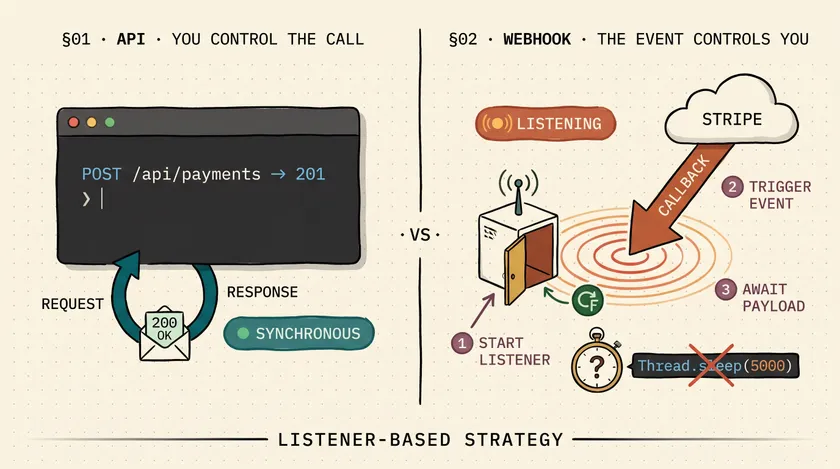
Table of Contents
We had 200+ API tests running green for months. Then the team added a payment webhook integration — Stripe sends a callback when a payment succeeds — and we tried testing it using the same request-response patterns. The tests passed locally about 70% of the time and failed in CI about 90% of the time. We spent a week debugging what we thought were environment issues before realizing the fundamental problem: webhook testing can’t use the same strategy as API testing, and treating them the same is why your tests are unreliable.
API Testing: You Control the Conversation
API testing is comfortable because you control both sides of the interaction. You send a request, you get a response, you assert on it. The flow is synchronous from the test’s perspective — even if the HTTP call is technically async, you wait for the response before asserting.
@Testpublic void createPayment_returnsConfirmation() {    Response response = given()        .body(new PaymentRequest("card_visa", 5000, "usd"))        .post("/api/payments");
    // You control the timing — assert immediately after the response    assertThat(response.statusCode()).isEqualTo(201);    assertThat(response.jsonPath().getString("status")).isEqualTo("pending");}
This is predictable. The test sends a request, waits for a response, and asserts. There’s no timing ambiguity. If the assertion fails, the data is wrong — not the timing.
Webhook Testing: The Event Controls You
Webhooks invert the relationship. You don’t call the webhook — the external system calls you. Your test has to:
- Set up a listener that can receive the callback
- Trigger the event that causes the webhook to fire
- Wait for the callback to arrive (or time out)
- Assert on the payload that was delivered
That “wait for the callback” step is where everything breaks. You don’t know when the webhook will fire. You don’t know how many times it might fire (retries). And in CI, you have an additional problem: the webhook sender needs a URL that actually reaches your test environment.
@Testpublic void paymentSucceeded_webhookDeliversPayload() throws Exception {    // Step 1: Start a listener BEFORE triggering the event    CompletableFuture<WebhookPayload> received = webhookListener.waitForEvent(        "payment_intent.succeeded", Duration.ofSeconds(30)    );
    // Step 2: Trigger the action that causes the webhook    stripeTestHelper.createSuccessfulPayment("card_visa", 5000, "usd");
    // Step 3: Block until the webhook arrives or timeout    WebhookPayload payload = received.get(30, TimeUnit.SECONDS);
    // Step 4: NOW you can assert    assertThat(payload.getType()).isEqualTo("payment_intent.succeeded");    assertThat(payload.getData().getAmount()).isEqualTo(5000);}
Notice the inversion. The listener starts before the triggering action. If you trigger first and then start listening, you might miss the webhook entirely — it could arrive in the milliseconds between the trigger and the listener starting.
Why Our API Test Patterns Failed
Here’s what we tried first (and why it failed):
// BAD — polling the database after triggering the event@Testpublic void paymentSucceeded_updatesDatabase() {    stripeTestHelper.createSuccessfulPayment("card_visa", 5000, "usd");
    // Poll the database hoping the webhook has been processed    Thread.sleep(5000); // How long is long enough? Nobody knows.    Payment payment = paymentRepository.findLatest();    assertThat(payment.getStatus()).isEqualTo("succeeded");}
The Thread.sleep(5000) is the telltale sign of a broken webhook test. Five seconds is enough locally but not in a slow CI environment. Ten seconds works in CI but makes your suite painfully slow. And any fixed sleep is a lie — you’re guessing at timing instead of waiting for the actual event.
The Strategy That Actually Works
After a week of pain, we settled on a three-part strategy that’s been reliable across three different projects since then.
Part 1: Build a Webhook Listener
Create a lightweight HTTP server in your test harness that receives webhook callbacks. This isn’t a mock — it’s a real endpoint that the webhook sender delivers to.
public class WebhookListener {    private final Map<String, CompletableFuture<WebhookPayload>> pending        = new ConcurrentHashMap<>();    private final HttpServer server;
    public WebhookListener(int port) throws IOException {        // Start a real HTTP server that receives webhook callbacks        server = HttpServer.create(new InetSocketAddress(port), 0);        server.createContext("/webhooks", this::handleWebhook);        server.start();    }
    public CompletableFuture<WebhookPayload> waitForEvent(        String eventType, Duration timeout) {        CompletableFuture<WebhookPayload> future = new CompletableFuture<>();        pending.put(eventType, future);        // Auto-timeout so tests don't hang forever        future.orTimeout(timeout.toMillis(), TimeUnit.MILLISECONDS);        return future;    }
    private void handleWebhook(HttpExchange exchange) throws IOException {        WebhookPayload payload = parsePayload(exchange);        CompletableFuture<WebhookPayload> future = pending.remove(payload.getType());        if (future != null) {            future.complete(payload);        }        exchange.sendResponseHeaders(200, 0);        exchange.close();    }}
The key is CompletableFuture — it lets the test block until the webhook arrives without polling. The orTimeout ensures tests fail fast instead of hanging indefinitely if the webhook never comes.
Part 2: Test Idempotency
Webhook providers retry on failure. Stripe retries up to 3 times. Your webhook handler needs to be idempotent, and your tests need to verify that.
@Testpublic void duplicateWebhook_processedOnlyOnce() throws Exception { WebhookPayload payload = createPaymentPayload("evt_123", 5000); // Deliver the same webhook twice webhookHandler.process(payload); webhookHandler.process(payload); // Should only create one payment record assertThat(paymentRepository.findByEventId("evt_123")).hasSize(1);}Part 3: Solve the CI Reachability Problem
This is the gotcha that catches everyone.
Three options, in order of my preference:
| Approach | Pros | Cons |
|---|---|---|
| Mock the webhook sender | Fast, no network dependency, works everywhere | Doesn’t test the real integration |
| Use a tunnel (ngrok/localtunnel) | Tests the real integration | Adds external dependency, can be flaky |
| Use provider’s test/CLI tools | Stripe CLI can forward webhooks locally | Provider-specific, not all providers offer this |
For CI, I recommend mocking the webhook sender and running the real integration tests in a staging environment on a schedule (nightly). Trying to make real webhooks work in ephemeral CI containers is a maintenance nightmare — I’ve seen teams spend more time maintaining the tunnel setup than writing actual tests.
@Testpublic void paymentWebhook_processesCorrectly() throws Exception {    // In CI: simulate the webhook delivery directly    WebhookPayload payload = createPaymentPayload("evt_test_123", 5000);    webhookHandler.process(payload);
    Payment payment = paymentRepository.findByEventId("evt_test_123");    assertThat(payment.getStatus()).isEqualTo("succeeded");    assertThat(payment.getAmount()).isEqualTo(5000);}
This tests your webhook processing logic without needing a reachable URL. Save the end-to-end webhook delivery test for a stable environment where the network is predictable.
Part 4: Verify Signature Validation
Idempotency prevents duplicate processing, but it doesn’t stop someone from crafting a fake payload and hitting your endpoint. If your webhook handler doesn’t verify the signature header, anyone who discovers your webhook URL can trigger fake payment events — and your system will happily process them. Stripe signs every payload with a secret; your handler should reject anything that doesn’t match.
@Testpublic void invalidSignature_rejectsPayload() {    WebhookPayload payload = createPaymentPayload("evt_123", 5000);    String invalidSignature = "invalid_sig_abc123";
    assertThrows(SignatureVerificationException.class, () ->        webhookHandler.processWithSignature(payload, invalidSignature)    );    // Verify the forged payload was never persisted    assertThat(paymentRepository.findByEventId("evt_123")).isEmpty();}
Don’t stop at invalid signatures — test for replay attacks too. Stripe’s signature header includes a timestamp, and your handler should reject payloads older than a threshold (we use 5 minutes). Re-sending a legitimately signed but stale payload is a real attack vector, and a one-line timestamp check in your handler plus one test to verify it closes that gap.
The Pattern I Use Now
After building webhook test infrastructure on three projects, the pattern is always the same:
- Unit test your webhook handler — mock the payload, verify processing logic, idempotency, and signature validation
- Integration test with a listener — real HTTP server, trigger real events in test mode, assert on received payloads
- E2E test in staging only — real webhook delivery from the provider, run nightly not on every PR
If you want to route webhook test failures to the right team in a multi-squad setup, the same squad tagging pattern we use for Cucumber scenarios works here too. And if your CI pipeline already uses GitHub Actions for test execution, the mock approach integrates cleanly without any additional infrastructure.
Your Next Step
Pick one webhook integration in your project. Write one test that verifies the happy path using a CompletableFuture listener instead of Thread.sleep. If that single test is more reliable than what you have now, you’ve got your pattern — apply it everywhere else.
Stop treating webhooks like APIs. They’re fundamentally different, and your testing strategy should reflect that.
Don't miss a thing
Subscribe to get updates straight to your inbox.

No spam · Unsubscribe anytime