Don't Make an LLM Your Visual Regression Gate
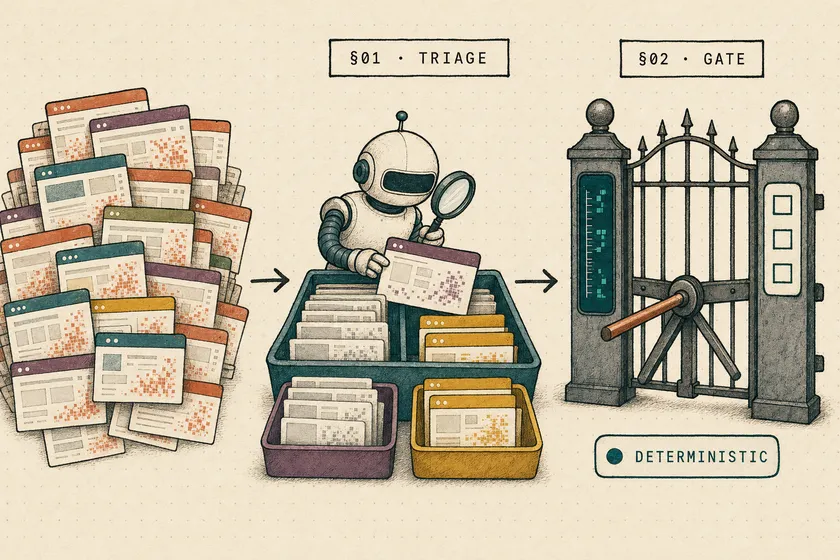
Table of Contents
The pitch lands in every visual-testing thread now: pixel-diff is too flaky, so stop comparing pixels and just ask a multimodal LLM “does this screenshot look right?” Wire GPT-4o or Claude into your Playwright suite, let it judge each render, and merge on its verdict. It’s seductive because the pain is real — but putting a non-deterministic model on the blocking path of your visual regression suite is the same category error that makes self-healing agents dangerous: you’ve made “looks fine to the model” the merge criterion instead of “provably unchanged.”
I’ve shipped visual suites at a large Canadian insurer where the pixel-diff false-positive rate hit roughly 40% and engineers were rubber-stamping diffs without looking. The fix wasn’t to hand the gate to an LLM. It was to keep a deterministic gate and put the LLM where it’s genuinely strong: triaging the flood, not approving the merge. That distinction is the whole post.
Why pixel-diff visual regression breaks at enterprise scale
Pixel comparison fails on the things humans don’t even perceive. Anti-aliasing shifts after an OS update, a font edge rendered differently between macOS and Windows, a dynamic ad slot one pixel off, a tooltip animating a frame early under CPU load — a person sees an identical page while the matcher sees thousands of changed pixels and fails the build. Applitools, Lost Pixel, and most visual-testing vendors all describe the same root cause: traditional screenshot comparison flags meaningless differences as failures.
~40%
False-positive rate (our insurer suite)
Diffs that were noise, not real regressions
Suite disabled
Common outcome
Some teams turn visual tests off entirely once noise wins
Masking
Top mitigation
Most-cited fix — and it hides real bugs too
The conventional fixes — threshold tuning and aggressive masking of dynamic regions — trade one failure mode for another. Loosen the threshold and real regressions slip under it. Mask aggressively and you’ve blindfolded the test over exactly the regions most likely to break. At our insurer, the cost wasn’t theoretical: reviewers went numb from noise and waved through a genuine color-contrast regression on a quote form — a WCAG accessibility defect that reached production because the signal was buried in false positives. That’s the real failure of pixel-diff at scale: not that it misses bugs, but that it trains your team to stop looking.
Why a multimodal LLM can’t be your blocking gate
Here’s the direct answer: a multimodal LLM is not deterministic or accurate enough to gate a merge, and a gate that gives different verdicts on the same input isn’t a gate. The benchmarks for the underlying skill — looking at a UI and reasoning precisely about it — are sobering once you leave the demo.
~80%
ScreenSpot-Pro best grounding
High-res pro apps, with a crop-refinement crutch
5% → 27%
OSWorld-G agentic success
Even fine-tuned grounding tops out low
Not guaranteed
Determinism at temp 0
Same screenshot can yield different verdicts
On ScreenSpot-Pro — 1,581 expert-annotated tasks across 23 professional applications — even strong models land around 73%, climbing into the low 80s only with a two-stage crop refinement. On OSWorld-G’s grounding benchmark, agentic success rises from 5% to 27% with purpose-built models. Those are the numbers for “can the model reliably reason about what’s on screen.” A gate that’s right four times in five, with verdicts that drift run to run, is not a gate — it’s a coin with opinions.
There’s also cost and reproducibility. A vision call per screenshot, across hundreds of specs on every PR, is real money and real latency — and when an auditor in a regulated shop asks “why did this build pass three weeks ago,” “the model felt good about it” is not an answer you want to give. This is the same trap as testing LLM features themselves: the moment a non-deterministic component sits on your pass/fail path, your suite inherits its non-determinism.
Where the LLM oracle actually earns its place: triage
The job pixel-diff does worst is the job a multimodal LLM does best: looking at a flagged diff and saying “that’s anti-aliasing noise” versus “a human needs to see this.” You keep the deterministic gate. The LLM never decides pass or fail — it decides who looks next, and in what order. It’s the visual-domain sibling of LLM triage for CI failures: same pattern, applied to screenshots instead of stack traces.
Keep Playwright’s deterministic comparison as the source of truth
Start with Playwright’s built-in deterministic comparison as the source of truth:
test('quote form renders unchanged', async ({ page }) => { await page.goto('/quote'); await page.getByTestId('dynamic-rate').evaluate(el => (el.textContent = '—')); // neutralize await expect(page).toHaveScreenshot('quote-form.png', { maxDiffPixels: 100 });});Classify the failed diff with structured output
When that assertion fails, you have a diff image. That is what the LLM looks at — not to overrule the failure, but to classify it. Pin the model to structured output so the result is parseable and auditable, never prose:
const verdict = await vision.classify({ baseline, candidate, diffMask, temperature: 0, // [!code highlight] schema: { category: ["anti_aliasing", "dynamic_content", "layout_shift", "real_regression"], confidence: "number", // 0..1 affects: ["text", "color", "spacing", "image", "none"], rationale: "string", // logged, never trusted as a gate },});// The build is ALREADY red. This only routes and ranks the review.Two non-negotiables make this safe. First, temperature: 0 and a fixed schema so the output is as stable and reviewable as a non-deterministic call gets. Second — the rule that keeps you out of trouble — the verdict can only rank and route, never resolve. A real_regression with high confidence jumps the review queue; an anti_aliasing verdict gets auto-collapsed but stays visible. The diff is still a failure until a human says otherwise.
The architecture I use
The whole design is one deterministic gate plus one advisory lane, with humans owning every actual pass/fail.
Keep a deterministic gate as the only thing that blocks
toHaveScreenshot (or an ARIA-snapshot assertion for structure) decides red or green. Nothing the LLM says can turn a red build green. The agent advises; the gate disposes.
Run the LLM only on already-failing diffs
No model call when the deterministic check passes — that’s where the cost and latency would balloon for zero value. The LLM sees a tiny fraction of renders: just the ones already flagged.
Classify, don't conclude — rank the human queue
The verdict reorders review. Likely-real regressions go to the top with the rationale attached; likely-noise is collapsed-but-auditable. Reviewers spend their attention where it pays.
Treat a 'real_regression' verdict as a tripwire, not a verdict
High-confidence real-regression calls page a human and tag the PR. False negatives here are the dangerous ones, so tune the model to over-flag — the cost of a wrong “looks real” is a wasted glance, not a shipped bug.
Wire the advisory lane into CI
In CI the gate and the triage lane stay strictly separated — the model runs as a non-blocking annotation step:
- run: npx playwright test --grep @visual # deterministic gate; can fail the job- if: failure() run: node scripts/triage/classify-diff.ts # advisory only continue-on-error: true # [!code highlight]# Defense in depth: the triage step must never mutate baselines or flip statusif git diff --name-only | grep -qE 'tests/visual/.*-snapshots/' ; then echo "::error::Triage step modified a baseline — that's the gate's job, not the model's"; exit 1fiAt the insurer, dropping this in front of a ~600-screenshot suite cut the diffs a human actually opened by more than two-thirds, while the contrast and layout regressions that used to drown in noise started landing at the top of the queue with a one-line rationale. We didn’t make the suite smarter at deciding — we made it smarter at deciding what’s worth a human’s eyes. The gate stayed dumb and deterministic on purpose. For the broader decision of when each Playwright AI surface earns its keep, I laid out the framework in MCP vs CLI vs Agents in 2026.
The one thing to do today
Don’t rip out pixel-diff and don’t hand the gate to a model. Instead, take your noisiest visual spec — the one your team has been ignoring or was about to delete — and put a multimodal LLM in front of its diff queue only, with temperature: 0, structured output, and a hard rule that it can rank but never resolve. Log the verdicts for two weeks, then measure its precision on your own UI before you trust a single auto-collapse. Keep the deterministic gate as the only thing that can fail a build. An LLM that triages your visual noise is a force multiplier; an LLM that approves your merges is green tests hiding real bugs wearing a smarter mask.
If you want more field-tested takes on running AI inside real enterprise test suites — the version with guardrails, not the demo — that’s what I write about here every week.
Can a multimodal LLM replace pixel-diff visual regression testing?
Not as the blocking gate. Models aren’t deterministic or accurate enough — GUI grounding benchmarks like ScreenSpot-Pro top out around 73–80%, and verdicts drift run to run even at temperature: 0. Keep a deterministic check (toHaveScreenshot or an ARIA snapshot) as the gate; use the LLM only to triage the diffs it flags.
Where should an LLM oracle sit in a visual testing pipeline?
In the triage lane. Run the deterministic comparison first; only on failure do you send the diff to the model to classify it as anti-aliasing, dynamic content, layout shift, or a real regression. The verdict ranks and routes human review — it never turns a red build green.
Why is a non-deterministic gate a problem in CI?
A gate’s value is reproducibility: same input, same verdict, erring toward blocking. An LLM verdict drifts between runs and is right ~4 times in 5 on grounding tasks, so gating on it means your suite inherits that non-determinism — and “the model felt good about it” is a bad answer in a regulated audit.
How do I keep the LLM triage step from masking real bugs?
The deterministic gate is the only thing that fails the build; the triage step is a non-blocking, continue-on-error annotation that ranks but never resolves; and a guard fails the job if triage ever mutates a baseline. Tune the model to over-flag — a wrong “looks real” costs a glance, a missed one ships.
Is it worth the API cost to run a vision model on every screenshot?
Only run it on already-failing diffs, never on passing renders — that keeps calls to a small fraction of the suite. Pixel-diff stays the cheap, deterministic first pass; the LLM is the expensive second opinion you spend only where a human would otherwise sift noise by hand.
Don't miss a thing
Subscribe to get updates straight to your inbox.

No spam · Unsubscribe anytime