Your Grounding Tests Pass. Retrieval Recall Dropped.
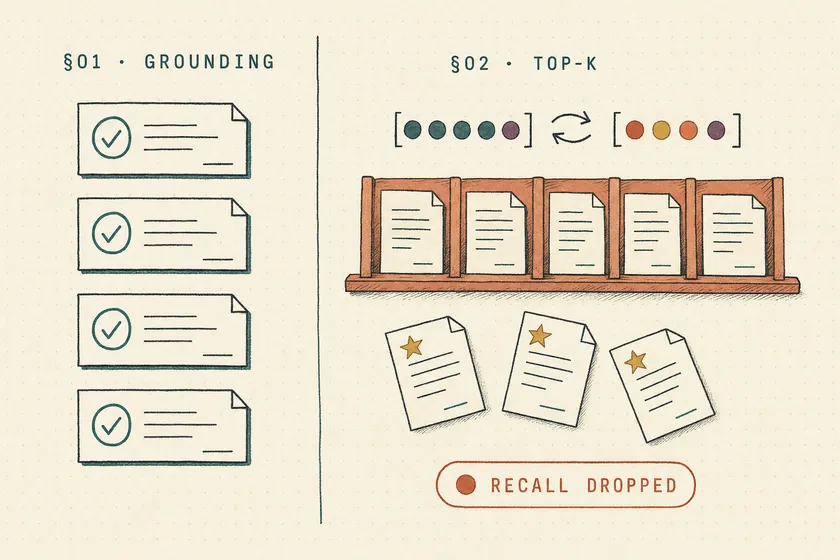
Table of Contents
Someone swapped the embedding model behind your RAG feature — text-embedding-3-small to something newer, or a re-chunk from 512 to 256 tokens, or a vendor bumped their endpoint. Your grounding suite stayed green. Every answer still cited a retrieved chunk, faithfulness still scored above threshold, and the deploy sailed through. Three weeks later support is drowning in “the assistant can’t find our refund policy anymore” tickets. The retrieval recall collapsed on a whole class of queries, and not one test noticed — because none of them were measuring recall.
This is the blind spot that sits directly underneath a grounding test. Grounding proves the answer was faithful to whatever got retrieved; it says nothing about whether the right documents were retrieved in the first place. A confidently grounded answer built on the wrong three chunks passes every faithfulness check you own. When you change the embedding model, the chunker, or the distance metric, retrieval quality is exactly the property that moves — and it’s the one property your green suite isn’t watching. Here’s how to build a deterministic recall@k gate in Playwright so a silent re-embedding can’t ship past you again.
Why do grounding tests pass while retrieval silently regresses?
Because grounding and recall measure two different relationships, and a regression in one is invisible to the other. Grounding (faithfulness) asks “is every claim in the answer supported by the retrieved context?” Recall asks “did we retrieve the documents that actually contain the answer?” A model can be perfectly faithful to a retrieved set that no longer includes the document it needs — it just answers thinly, or hedges, or grounds itself in a near-miss chunk. Faithfulness stays high; the answer gets worse.
I covered the grounding half of this in why a correct RAG answer can still be hallucinated — attribution and faithfulness are the layers you check after retrieval. This post is the layer underneath: retrieval recall itself. In RAG evaluation, recall@k measures whether the relevant documents appear among the top-k retrieved, and missing a single essential chunk is enough to make the final answer incomplete or wrong.
grounding
Answer ⊆ retrieved
Faithful to what came back
recall@k
Gold ⊆ retrieved
The right docs came back
0
Grounding tests that measure recall
They can't — different relationship
That last column is the trap. Your grounding suite reads the answer and the retrieved context; it never compares the retrieved set against a labeled ground truth. So when recall drops from 0.94 to 0.70 after a re-index, the grounding tests keep passing on the queries that still work, and the ones that broke degrade into vague-but-faithful answers that no assertion is shaped to catch.
What actually changes recall when you “just” upgrade embeddings?
Almost everything about the retrieval stack is a lever on recall, and the three most common “harmless” changes each move it. Swapping the embedding model, re-chunking, or changing the distance metric are not config tweaks — they re-draw the vector space, and documents that used to land in the top-k fall out of it.
The model swap that ranks higher but retrieves worse
Start with the model swap, because it’s the one that hides behind a higher benchmark number. On the MTEB leaderboard, NV-Embed-v2 posts a 72.31 overall score yet a retrieval score of 62.65 — trailing Gemini Embedding 001’s retrieval score of 67.71 despite a lower headline average. “We moved to the higher-ranked model” can mean you moved to worse retrieval. And the swings are large: domain-adapting an embedding model has been shown to move Recall@1 from 34.3% to 62.8% on a finance corpus — the same magnitude of change, in the wrong direction, is what a bad migration does to you.
| Change someone calls “harmless” | What it actually does | Recall failure mode |
|---|---|---|
| New embedding model | Re-draws the entire vector space | Old top-k docs no longer near the query |
| Smaller / larger chunks | Splits or dilutes the answer span | Answer span crosses a new chunk boundary |
| Cosine → dot product | Rewards vector magnitude, not just direction | Long, high-norm chunks crowd out the right one |
| Re-embed without re-index | Mixes two incompatible spaces | Query and docs measured in different geometries |
Chunking, normalization, and the distance-metric trap
Chunking alone is worth up to a 9% swing in retrieval recall depending on strategy, and the optimal size is query-dependent — fact-heavy lookups favor small chunks, summaries favor overlap. The distance-metric trap is subtler: cosine similarity equals dot product only when vectors are normalized to unit length, so flipping the metric without renormalizing silently changes which neighbors win.
How do you build a labeled retrieval gold set?
You write down, for a fixed list of real queries, which document IDs must appear in the retrieved set — and you freeze it. This is the piece teams skip, and it’s the only thing that turns “retrieval feels fine” into a number a test can block on. The gold set is small, hand-labeled, and version-controlled next to the suite; it is your ground truth, so it can’t drift with the index.
Pick queries from real traffic, not your demo
Pull 20–40 questions from actual logs, weighted toward the ones that matter — refunds, auth, pricing, anything with a compliance blast radius. Include the awkward paraphrases customers actually type, because those are the first to fall out of the top-k after a re-embed.
Label the must-retrieve document IDs by hand
For each query, record the chunk or document IDs that genuinely contain the answer. Two or three per query is plenty. These IDs are stable identifiers from your corpus, not embeddings — so they survive a model swap, which is exactly why they make a valid baseline.
Freeze it and set a floor per query
Commit the gold set as JSON with a recall floor per query (say 1.0 for single-doc facts, 0.8 for multi-doc topics). Freeze it the same way you’d freeze AI-generated tests once reviewed — a baseline that moves with the system it measures isn’t a baseline.
The labeling is a few hours of a senior engineer’s time, once. Compare that to the cost of finding out from a customer that your assistant went blind on the refund policy for a sprint.
How do you assert recall@k in Playwright?
Intercept the retrieval call, read the ranked chunk IDs off it, and compare them to your gold set with a plain function — no model, no judge, no flakiness. This is the same move that makes attribution checks deterministic: Playwright watches the network while it drives the UI, so you capture exactly what the retriever returned before the generator ever sees it.
test('retrieval recall@5 holds for the enterprise-refund query', async ({ page }) => {  const chat = new ChatPanel(page);  await chat.goto();
  // Retrieval fires before the model call — capture the ranked result set.  const retrieval = page.waitForResponse(r =>    r.url().includes('/api/retrieve') && r.ok());  await chat.ask('What is the refund window for enterprise plans?');
  const { chunks } = await (await retrieval).json();  const retrievedIds = chunks.map((c) => c.id); // ranked, best-first});
Recall@k is a five-line pure function. Because it only compares ID sets, it is as deterministic as any assertion in your suite — the non-determinism of the model never enters it.
// Fraction of must-hit gold docs that land in the top-k retrieved results.export function recallAtK(retrieved: string[], gold: string[], k: number): number { const topK = new Set(retrieved.slice(0, k)); const hits = gold.filter((id) => topK.has(id)).length; return gold.length === 0 ? 1 : hits / gold.length;}Now wire the frozen gold set into a hard expect. When recall drops below the floor, the failure message names the query and the specific missing document — so the person triaging sees “we stopped retrieving policy-refund-ent-v3” instead of “the eval score went down.”
import gold from './retrieval-goldset.json'; // frozen: query -> { mustRetrieve, k, floor }import { recallAtK } from './recall';
const { mustRetrieve, k, floor } = gold['enterprise-refund']; const missing = mustRetrieve.filter((id) => !retrievedIds.slice(0, k).includes(id)); const recall = recallAtK(retrievedIds, mustRetrieve, k); expect(recall, `recall@${k} = ${recall.toFixed(2)} < floor ${floor}; missing: ${missing.join(', ')}`) .toBeGreaterThanOrEqual(floor);Where should the recall gate run — PR or nightly?
Both, split by cost — and this is the part that makes recall testing practical instead of aspirational. The deterministic ID-set check is cheap and never flaky, so the per-query recall floor belongs in the blocking PR suite against a recorded index snapshot. The expensive part — re-embedding the whole corpus and measuring aggregate recall across the full gold set — runs nightly.
PR gate: recall@k against a snapshot index
Run the frozen gold queries against a pinned index built with the current embedding contract. Mock the generator so you’re only exercising retrieval — this is a mocked-model lane, fast and deterministic. Any query dropping below its floor blocks the merge.
Nightly gate: full re-embed, aggregate recall
Rebuild the index with the real embedding model and measure mean recall@k across the whole gold set. Alert on a drop past a delta, don’t block — this is the same scheduled pattern as a model-drift eval gate, and it catches vendor-side endpoint changes you didn’t initiate.
Add one guardrail above both, because the cheapest bug to catch is the contract mismatch itself. A single deterministic test that asserts the live index was built with the embedding model, dimension, and distance metric you expect will fail instantly on a botched re-embed — before recall even runs.
test('vector index matches the embedding contract it was built with', async ({ request }) => { const meta = await (await request.get('/api/index/meta')).json(); // Model + dimension + distance are one contract; a mismatch means a bad re-index. expect(meta.embeddingModel).toBe('text-embedding-3-large'); expect(meta.dimensions).toBe(3072); expect(meta.distance).toBe('cosine'); // dot-product on unnormalized vectors != cosine});What I’d do differently
The regression that taught me this shipped at a large financial-services client. A platform team re-chunked the knowledge base from 512 to 256 tokens to “improve precision,” re-embedded overnight, and deployed. Every grounding and faithfulness test passed, because the answers that still worked were still faithful. What nobody measured: recall@5 on our labeled policy queries fell from 0.94 to 0.71. For three weeks the assistant gave confident, well-grounded, subtly incomplete answers on split-across-boundary questions, and the only signal was a slow rise in “it used to know this” tickets. We were paying for a green suite that measured the wrong relationship.
Before
Grounding + faithfulness suite — all green, recall unmeasured
After
Deterministic recall@k gate + index-contract check on a frozen gold set
Two things I’d do from day one now. First, label the gold set before the first RAG feature ships, not after the first incident — it’s a few hours that would have turned a three-week outage into a red build. Second, I’d make the index-contract test the very first check in the suite, because the day we finally debugged it, the root cause was a distance metric that had silently flipped to dot product on unnormalized vectors — a one-line assertion would have caught it in seconds instead of days.
Your one concrete next step
Take your single highest-traffic RAG query and give it a gold label today: the two or three document IDs that must be retrieved to answer it. Then write the recall@5 assertion — capture /api/retrieve, run the five-line recallAtK, assert it clears a floor. That’s fifteen lines, it runs in your existing Playwright suite with no judge and no new infrastructure, and it will catch the silent re-embedding regression that your grounding tests are structurally blind to. Add the full nightly re-embed comparison later; ship the deterministic floor first.
If you want more field-tested QA automation breakdowns like this — no fluff, just what actually holds up at enterprise scale — subscribe below. And if you’re formalizing how your team tests AI features, the rest of the AI-powered testing pillar goes deep on grounding, judges, drift, and mocking strategy.
What's the difference between grounding tests and retrieval recall tests?
Grounding (faithfulness) checks that the answer’s claims are supported by whatever was retrieved. Retrieval recall checks that the documents actually containing the answer were retrieved at all. They fail independently — an answer can be perfectly faithful to a retrieved set that no longer includes the right document, so faithfulness stays green while the answer quietly degrades. The fix is a separate recall@k gate that compares the retrieved set against a labeled gold set, layered under the grounding checks.
Why did my RAG recall drop after upgrading the embedding model?
Because a new model re-draws the entire vector space, so documents that used to land in the top-k can fall out of it. A higher overall MTEB score doesn’t guarantee better retrieval — retrieval is a specific sub-score, and a model can rank higher overall while retrieving worse. Re-chunking and flipping the distance metric do the same thing. Treat the embedding model, chunking, normalization, and distance metric as one contract; changing any part is a version bump that needs a recall regression test.
How do you measure recall@k in a Playwright test?
Intercept the retrieval call with page.waitForResponse, read the ranked chunk IDs off the response, and compare them to a frozen gold set of must-retrieve document IDs. Recall@k is the fraction of gold docs that appear in the top-k — a five-line pure function. It’s fully deterministic because it only compares ID sets and never reads model prose, so it belongs in the blocking suite.
Should the retrieval recall gate block pull requests?
Yes, in a split. Run the deterministic per-query recall@k floor against a pinned index snapshot on every PR with the generator mocked — cheap and never flaky. Run the expensive full-corpus re-embed and aggregate recall nightly as a non-blocking alert to catch vendor-side changes, the same way you’d run a scheduled drift gate. Add an index-contract test asserting the model, dimensions, and distance metric so a botched re-index fails instantly.
Don't miss a thing
Subscribe to get updates straight to your inbox.

No spam · Unsubscribe anytime